
Getting Ashland County Court Records
Start with Wisconsin Circuit Court Access (WCCA). Pick Ashland County, then search by case number if you have one. A name search works too. But confirm the county, caption, and case type before trusting a match.
For ordinary or certified copies, use the county court-record request form. You can also walk into Room 307 or call the clerk at 715-682-7016. The clerk does not publish a full mail, fax, email, or drop-box procedure. Ask about those arrangements before sending anything.
- Search WCCA and record the exact case number, caption, type, and filing year.
- Decide whether the free case-information view is enough or a filed document is needed.
- Give the SMARTFORM your contact details, party name, case number if known, year, type, and requested item.
- Choose ordinary or certified records and wait for the cost and delivery estimate.
- Call or visit for older, restricted, large, or unusually certified files.
Three Layers of a Case File
A search result is not the whole file. The portal splits summary details from event history, and the Clerk of Circuit Court keeps the actual documents behind each entry.
- Case information
- Case number, caption, filing date, type, status, court, judge, and public party data.
- Register of actions
- The dated sequence of filings, notices, hearings, orders, continuances, judgments, payments, and dispositions.
- Filed documents
- The complaint, petition, order, judgment, transcript, exhibit, or other document itself. An event title does not guarantee a downloadable image.
Say a result lists a judgment or an order. That row may not show the wording itself, so ask the clerk for the named document instead of treating the entry as the full decision.
Court Record Types
The Clerk of Circuit Court keeps civil, criminal, family, small-claims, traffic, and other circuit files. Probate and juvenile matters are different. A separate Register in Probate/Juvenile Court Clerk handles them. Confidentiality can limit what that office releases. What the public sees on WCCA does not settle the question.
| Record | What It Provides | Best Route |
|---|---|---|
| Register of actions | Chronology of events and settings | WCCA first; clerk for an official copy |
| Complaint or petition | Initial claims or allegations | SMARTFORM or clerk |
| Judgment or disposition | Outcome, sentence, or final ruling | SMARTFORM |
| Divorce decree | Final family document, subject to access rules | SMARTFORM or clerk review |
| Probate or juvenile material | Specialized administration records | Register in Probate/Juvenile Court Clerk |
Using the Ashland Records SMARTFORM
The form asks for your name, email, and phone. It also asks whether you want ordinary or certified copies, the case-party name, and the case type. A case number and the years to search are optional. They cut confusion and spare the clerk extra work.
Its checklist covers Complaint/Petition, Judgment of Conviction/Sentence, Final Judgment, Disposition, Divorce Decree/Marital Settlement Agreement, and a pardon-related certified copy. Need a docket sheet, order, exhibit, or other filing? Pick "Other" and describe it. The official county form is where document ordering begins.
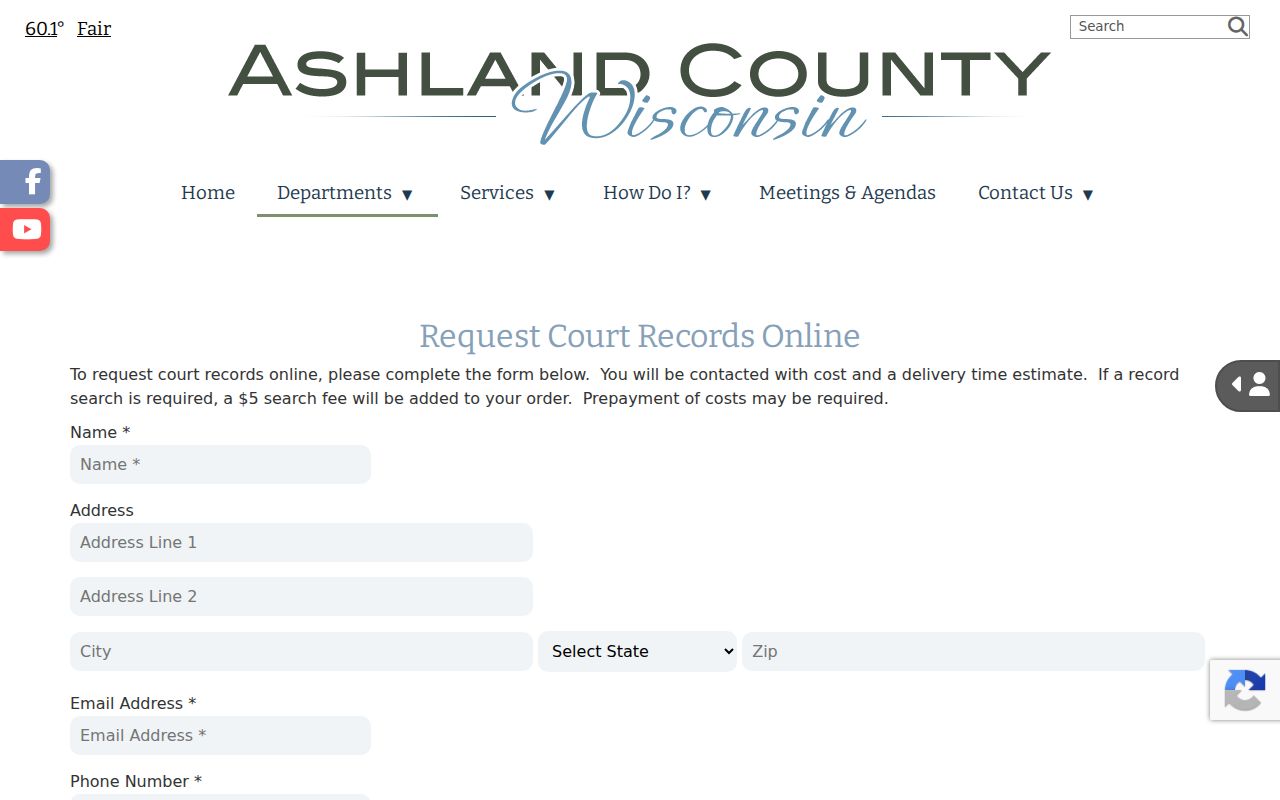
The official form keeps two tasks separate: requesting copies and running a WCCA case search. It also spells out the details the clerk expects from you.
Inside an Ashland County Court Record
What you get depends on the case and its access level. A case view names the proceeding and lays out its chronology, while a requested document carries the actual filed text. Sealed or restricted items may simply be left out.
| Case Number | Unique circuit identifier used to match the request and search result. |
|---|---|
| Caption and Parties | Case style and public party roles. |
| Filing Date and Type | When the matter began and its classification. |
| Register Events | Filings, motions, notices, settings, orders, judgments, payments, and disposition. |
| Orders and Judgments | Decisions that may require a separate request to read fully. |
| Exhibits and Transcripts | Materials with separate availability, preparation, or redaction requirements. |
Choosing the Document You Need
Ask for the narrowest record that does the job. For dates and outcomes, the register may be enough. For allegations, request the complaint or petition. For final action, request the right document. That means the disposition, judgment, judgment of conviction and sentence, or divorce decree.
A register event is a clue, not the document it names. A hearing entry proves a proceeding happened, not that a transcript exists. An order entry gives a date and title, not the signed order's full terms. Exhibits may get special handling. A transcript usually comes through a court reporter rather than an ordinary clerk copy. Call ahead for either.
Certification authenticates the copy; it does not unlock confidential content. Printing from WCCA does not create a clerk-certified record either. When exact wording or authentication matters, name the document and the certification need together. Also say whether every filing needs certification. Maybe only the final judgment does. The published certification charge applies per document.
Fees and Certified Copies
A plain copy just reproduces what is available. A certified copy adds the clerk's certification. Ashland County sends a cost and delivery estimate and may want prepayment. The county lists no separate exemplified-copy fee, so ask rather than guess a price.
| Item | Published Amount |
|---|---|
| Plain court record | $1.25 per page |
| Certified-copy pages | $1.25 per page |
| Certification | $5.00 per document |
| Search when required | $5.00 |
| Exemplified copy | Not published; ask the clerk |
Ashland County Clerk of Circuit Court
201 Main Street West, Room 307
Ashland, WI 54806
715-682-7016
Why the Clerk Sends an Estimate
Why an estimate instead of a fixed price? Several things move the total. Page count, certification, search work, delivery, and how many documents you want. The estimate also gives the office a chance to question vague wording. A party name alone may match several matters. "All records" can reach far past one judgment or order.
If the clerk asks for clarification, reply with the exact case number and date range. The form does not require a case number. Even so, include one you pulled from WCCA. Listing each case separately helps the clerk track separate files and certification charges. The office promises no turnaround time. State any real deadline. Do not assume it can be met.
Payment Is Not Record Search
The county payment page takes cash, check, money order, card, and Allpaid. Allpaid location code 1054 sends your money to the clerk, nothing more. It will not search WCCA or order documents. The system may ask. The county says to enter the case number in both the case-number and citation fields.
Keep the channels separate: use WCCA to identify a case, the SMARTFORM or clerk to request records, and payment instructions only after receiving an amount and direction.
Sealed Records and Public Access
Wisconsin court records are presumptively open, but statutes, rules, sealing orders, redaction, and confidentiality all carve out exceptions. WCCA's display rules are not the same as the clerk's legal custody. When a search comes up empty, the cause might be your search terms, older data, a restricted case, or material released only after clerk review.
Key Rules:
Wis. Stat. § 19.31 states the policy favoring broad records access.
Wis. Stat. § 19.35 addresses inspection, copies, and requests.
Wis. Stat. § 801.21 governs motions to seal court records.
Wis. Stat. § 938.396 limits access to juvenile records.
Court Files and City Records Differ
County and city records live in different places. The county clerk holds circuit court files, while city clerks hold city administrative records. Council minutes, police administrative records, and parking-payment entries stay city records. They can feel very official. Even so, they never become court-register events just because local government produced them.
Does your ordinance citation show up as a circuit matter? Then search WCCA and ask the county clerk for its court file. For city-only material, start with the city custodian. Give a precise date, subject, case number, or document title. That way the right office handles the request the first time.